Jargon Buster
What is Pole Position in MotoGP?
Pole position is the very first starting spot on the grid. This guide explains how riders earn P1 in qualifying and why it offers a huge advantage in a MotoGP race.
Independent fan site — not affiliated with MotoGP or MotoGP Sports Entertainment Group (formerly Dorna).
Pole positionFirst place on the starting grid, earned by the fastest qualifying lap.Read the full guide →: The first starting spot on the grid for the main Grand Prix race.
If you’re new to MotoGP, you’ll hear commentators talk endlessly about ‘pole position’. In simple terms, it’s the very best place to start a race from. It’s the spot at the very front, marked with a number ‘1’, and it’s a prize every single rider on the grid wants to win before the main event even begins.
Earning pole position means a rider has proven they are the fastest person on the track over a single, blistering lap. But how do they get there, and how much does it really help when the lights go out on Sunday?
How is pole position decided?
Pole position isn’t given to the rider who was fastest in PracticeSessions before qualifying where riders set up the bike; the top ten in Friday afternoon's Practice go straight to Q2.Read the full guide →. Instead, it’s the ultimate prize in a tense, high-stakes shootout called QualifyingThe timed sessions that set the starting order, split into Q1 and Q2 for the front rows.Read the full guide →, which takes place on the Saturday of a race weekend.
The process has a couple of stages. First, the results of Friday afternoon’s Practice session are used to split the grid (Friday morning’s FP1 doesn’t count for this). The ten fastest riders automatically get a pass into the main qualifying event, known as Qualifying 2 (or Q2).
Everyone else has to fight it out in Qualifying 1 (Q1). In this first 15-minute session, the slower riders from practice get one last chance to set a fast lap. Only the top two from Q1 are allowed to advance, joining the ten riders who are already waiting.
This leads to the main event: Q2. This is the final, 15-minute dash where the 12 fastest riders of the weekend battle for the top spots on the grid. The rider who sets the single quickest lap time during this session is declared the ‘pole-sitter’ and earns the right to start from pole position.
What does the starting grid look like?
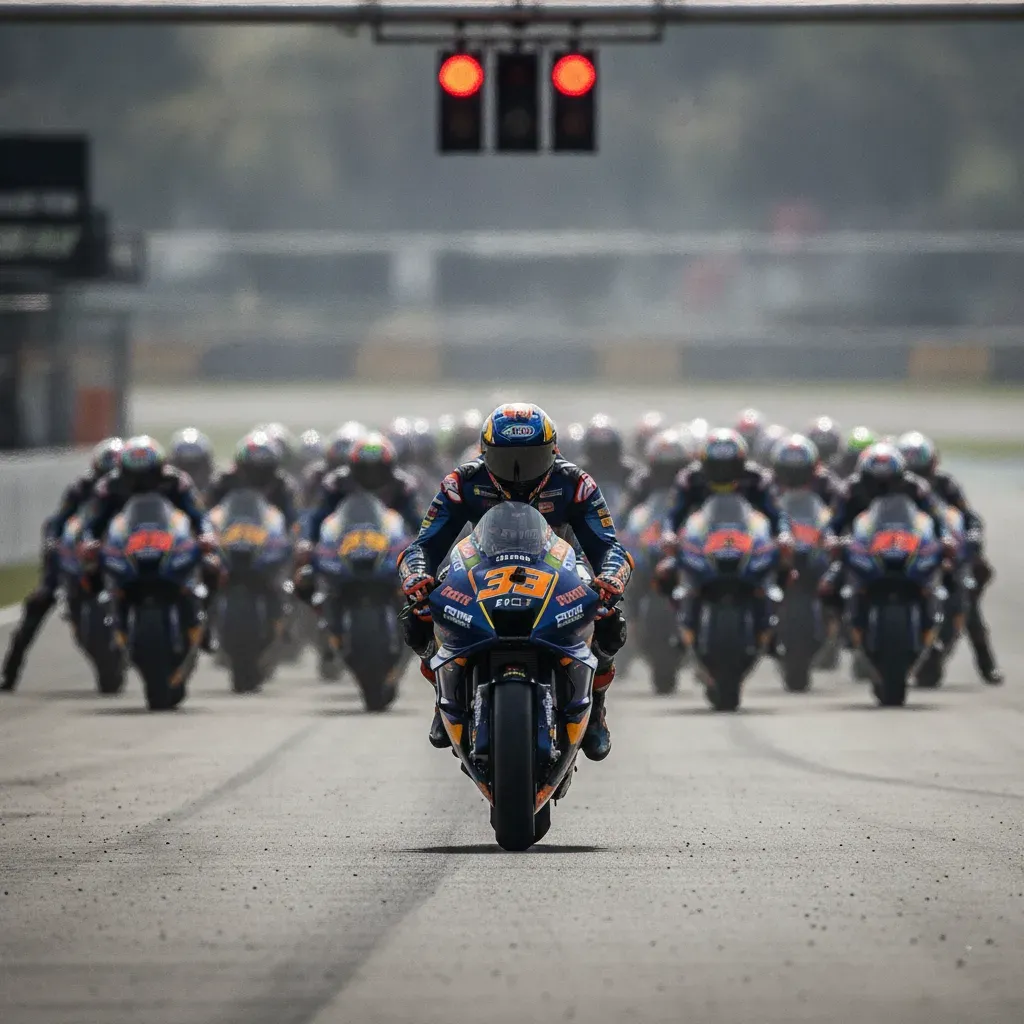
The MotoGP starting grid is organised in rows of three. Pole position is the front-row spot on whichever side gives the best line into the first corner, so it varies from circuit to circuit, and it gives that rider the cleanest and most direct path into that corner.
The rider who was second-fastest in Q2 lines up next to them, with the third-fastest completing the front row. The rest of the 12 riders from Q2 fill out the first four rows of the grid, all based on their qualifying lap times.
Riders who took part in Q1 but didn’t make it into the top two will line up from 13th place backwards. Their positions are also determined by the fastest laps they managed to set during their own Q1 session.
Why is starting from pole so important?
Starting at the very front gives a rider several huge advantages, especially in the frantic opening moments of a race.
The most obvious benefit is having a clear, empty track ahead. The pole-sitter doesn’t have to worry about navigating around other bikes and can focus entirely on getting a perfect start. This massively reduces the risk of being caught up in an accident, which is much more common in the tightly-packed midfield.
It also gives the rider access to ‘clean air’. A MotoGP bike’s WingletsSmall wings on the bodywork that create downforce to keep the front wheel down and improve stability.Read the full guide → and bodywork are designed to work perfectly in undisturbed air. When riding behind another bike, the turbulent or ‘dirty’ air it creates can upset the handling and aerodynamics, making the bike harder to control. The pole-sitter has no such problem.
Finally, it’s a massive strategic and psychological advantage. By leading from the front, a rider can try to set their own pace, break away from the pack, and manage their tyres without getting into messy battles. It’s a declaration that, on that day, on that track, they were the fastest of all.
Does the pole-sitter always win the race?
Absolutely not. While it’s the best possible place to start, securing pole position is no guarantee of victory. A Grand Prix is long and demanding, and being fast over a single lap is very different from being fast for 25 consecutive laps.
Many factors can change the outcome. A rider might have a bike that is perfect for a quick qualifying lap on soft, grippy tyres, but struggles with tyre wear over a full race distance. Others might be masters of race craft, able to fight their way through the pack from further down the grid.
A poor start, a small mistake, or changing weather can instantly erase the advantage of pole position. Ultimately, the winner is the rider who best manages their race pace, their tyres, and the pressure of competition, regardless of where they started.
What about the Sprint race?
One of the most important things to know is that the Saturday qualifying session is doubly important. The results don’t just set the grid for the main Grand Prix on Sunday; they also determine the starting order for the shorter Sprint raceA short Saturday race over half the distance, awarding points to the top nine finishers.Read the full guide → held on Saturday afternoon.
This means the pole-sitter gets to start from the front for both races over the weekend. It gives them two opportunities to turn their incredible one-lap speed into valuable championship points.
Quick Takeaways
- Pole position is the first spot on the starting grid, earned by setting the fastest lap in Saturday’s Q2 qualifying session.
- It offers a major advantage: a clear track, no turbulent ‘dirty’ air from other bikes, and the chance to control the start of the race.
- The starting grid is organised in rows of three, with the fastest 12 riders from qualifying filling the first four rows.
- While a huge benefit, starting on pole is no guarantee of winning the race, as tyre wear, race pace, and strategy are crucial over a full distance.
Quick questions
- Q.How many riders are on the MotoGP grid?
- The full-time MotoGP grid is typically made up of around 22 riders from 11 teams. The starting order for all of them is determined by their performance in the Saturday qualifying sessions.
- Q.Does the rider on pole get any championship points?
- No, there are no championship points awarded for securing pole position itself. Points are only awarded for finishing positions in the Saturday Sprint and the main Sunday Grand Prix race.
- Q.What is a 'pole-sitter'?
- 'Pole-sitter' is simply the term used for the rider who has earned pole position for a particular Grand Prix.