Jargon Buster
Yellow vs Double Yellow Flags in MotoGP
Confused by flags in MotoGP? Learn the crucial difference between a single yellow flag and a double yellow flag and why missing this signal is so dangerous.
Independent fan site — not affiliated with MotoGP or MotoGP Sports Entertainment Group (formerly Dorna).
The Silent Language of the Racetrack
Imagine 22 of the world’s fastest prototype motorcycles, inches apart, screaming down a straight at over 220 mph. In this world of extreme speed and noise, riders can’t exactly have a chat. Instead, they rely on a simple, silent, and critically important language: the marshal’s flags.
Flags are the official way race organisers communicate with riders on track. They signal everything from a slippery surface to the end of the race. Among the most important are the Yellow flagA warning of danger ahead — slow down and do not overtake in that zone.Read the full guide →, which are all about one thing: DANGER.
But not all yellow flags are created equal. Understanding the difference between a single waved yellow and two waved together is key to understanding rider safety and the rules that govern this incredible sport.
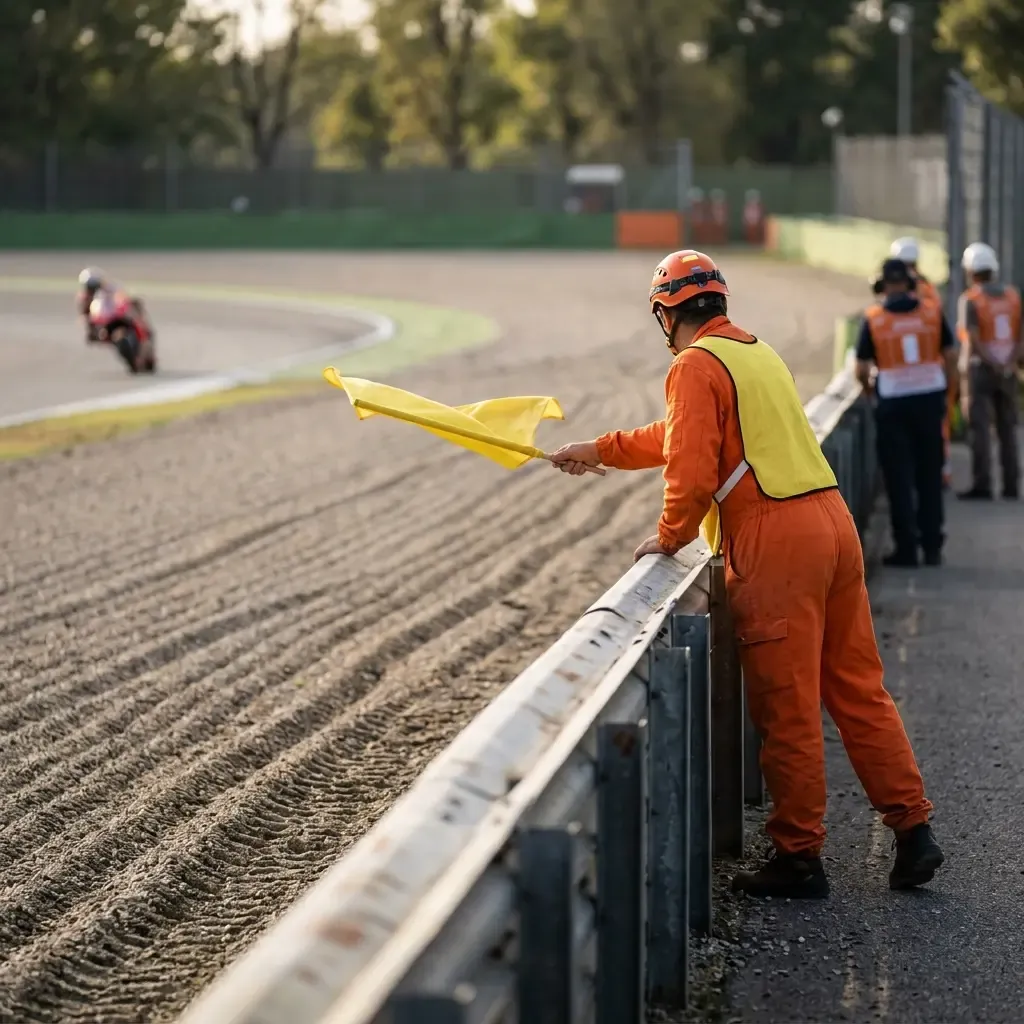
The Single Waved Yellow Flag: A Heads-Up
Single Waved Yellow Flag: A warning that there is a hazard ahead, beside the track. The danger is nearby, but not on the racing surface itself.
You will see a marshal wave a single yellow flag when, for example, a rider has run wide and fallen in a gravel trap, or if there is a small piece of debris near the edge of the circuit. The immediate danger is contained, but everyone needs to be aware of the situation unfolding nearby.
When a rider sees a single yellow flag, they must slow down and proceed with caution through that section of the track. Crucially, overtaking is strictly forbidden until the point where a green flag is waved. Doing so will earn the rider a penalty.
The Double Waved Yellow Flag: A Serious Warning
Double Waved Yellow Flag: A warning that the hazard is partly or wholly blocking the track itself. It’s the difference between a car stopped on the hard shoulder and one stopped in a lane of the motorway.
Here’s the part that surprises many fans: the rules say the number of yellow flags does not show how serious the danger is, only where it is. Two yellow flags waved together mean the obstacle is on the racing surface, such as a crashed motorcycle stranded on the Racing lineThe fastest path through a corner — usually wide on the way in, clipping the apex, then wide again on the way out.Read the full guide → or marshals working on the circuit to clear debris. (Oil or fluid on the track gets a flag of its own: yellow with red stripes.)

The rule for riders is the same as for a single flag: slow down and proceed with caution. But because the hazard may be right in their path, they need to be ready to change their line or take avoiding action. This signal gives oncoming riders the vital time they need to react safely.
Overtaking is, of course, completely out of the question. Ignoring yellow flags is one of the most serious offences a rider can commit, and the FIM MotoGP Stewards, the panel of officials who enforce the rules, will issue penalties.
Why The Difference is Critical for Safety
A rider approaching a corner at 180 mph needs to know instantly where the danger is. A single flag tells them ‘Something has happened beside the track’, while a double flag says ‘The track itself is partly or fully blocked, so expect something in your path.’
Think about the physics. These bikes and riders weigh over 200kg and have very little time to react. The flags, deployed instantly by highly trained trackside marshals, provide the earliest possible warning of danger.
For example, if a rider crashes on the exit of a blind corner and the bike is left lying on the track, the marshals at that post will immediately wave double yellow flags. This warns the next rider, who can’t yet see the crash scene, that they must reduce their speed before they even get to the corner. This prevents them from arriving at the scene at full racing speed, which could be catastrophic for everyone involved.

So next time you’re watching a race and see the flash of yellow, look closely. Are the marshals waving one flag or two? Now you know the difference and can appreciate the split-second decisions and incredible bravery shown by both the riders and the marshals who keep them safe.
Quick Takeaways
- Single Yellow Flag: The danger is BESIDE the track, like a bike in a gravel trap. Riders must slow down and are not allowed to overtake.
- Double Yellow Flag: The danger is ON the track, partly or fully blocking it. Riders must slow down and be ready to take avoiding action.
- Location, not severity: The number of flags shows where the hazard is, not how dangerous it is.
- Overtaking: It is forbidden under both single and double yellow flags. Ignoring this rule results in a penalty, and in PracticeSessions before qualifying where riders set up the bike; the top ten in Friday afternoon's Practice go straight to Q2.Read the full guide → or QualifyingThe timed sessions that set the starting order, split into Q1 and Q2 for the front rows.Read the full guide →, the lap time is cancelled.
- The Goal is Safety: These flags are the primary tool used by track marshals to prevent further incidents and protect fallen riders.